
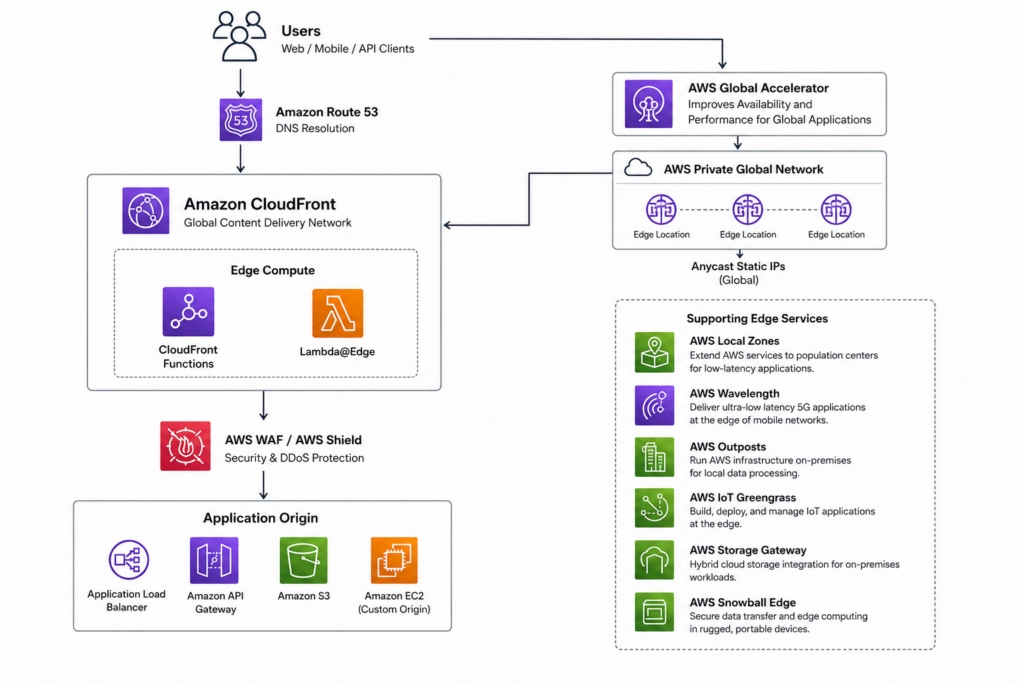
When most people hear the term AWS Edge Services, the first service that comes to mind is usually Amazon CloudFront.
That was also my first impression when I started learning about this topic.
I thought CloudFront was simply AWS’s Content Delivery Network (CDN). The more I worked with it, the more I realised that CloudFront is only one part of a much larger ecosystem.
AWS has built a global Edge infrastructure that includes networking, security, compute and storage services. All of them are designed with one goal in mind: bringing applications closer to users.
Why Did Edge Computing Become So Important?
For many years, applications followed a very simple model.
A user would open a website or mobile application, send a request over the Internet, wait for the application to process it inside a data centre or cloud region, and finally receive a response.
This model still works perfectly well for many applications.
So… what changed?
The way we use the Internet.
Today we have billions of smartphones connected all the time. We have IoT devices generating data every second. We stream high-definition video, play online games, join video calls and build applications that need to react almost instantly.
The problem is that every kilometre between the user and the application adds a little more latency.
For some applications, that isn’t a big deal.
For others, it makes all the difference.
Imagine an autonomous vehicle waiting hundreds of milliseconds before deciding whether to brake.
Or an industrial system waiting for a cloud region to detect that a machine is overheating.
Those are situations where waiting simply isn’t an option.
This is where Edge Computing comes into the picture.
Instead of sending every request to a cloud region that might be thousands of kilometres away, part of the processing happens much closer to where the data is generated.
The cloud doesn’t disappear.
It simply focuses on what it does best: storage, analytics, machine learning and centralized management.
The Edge handles the operations that benefit from immediate responses.
The AWS Global Edge Network
To make this possible, AWS has built one of the largest private networks in the world.
Beyond Regions and Availability Zones, AWS operates hundreds of Edge Locations and Regional Edge Caches, connected through its own global backbone.
This infrastructure allows AWS to move services much closer to end users without customers having to build their own worldwide network.
When someone accesses your application, the request doesn’t always need to travel directly to your origin server.
In many situations, AWS can process, inspect, secure or even respond to that request from the Edge.
That’s the foundation of AWS Edge Architecture.
The Five Building Blocks of AWS Edge Architecture
I find it easier to think about AWS Edge Services as five different categories rather than as individual products.
Each category solves a different problem.
Together, they create a complete Edge platform.
1. Content Delivery
This is where most people begin.
The main service is Amazon CloudFront, AWS’s global Content Delivery Network.
CloudFront stores copies of your content in Edge Locations around the world, allowing users to download websites, images, APIs and videos from locations much closer to them.
Most of this series will focus on CloudFront because it is the service that connects almost everything else together.
2. Edge Compute
Sometimes delivering cached content isn’t enough.
Applications often need to execute logic before a request reaches the backend.
AWS provides several services for that, including:
- Lambda@Edge
- CloudFront Functions
- AWS Local Zones
- AWS Wavelength
- AWS Outposts
- AWS IoT Greengrass
Although these services are very different, they all have one thing in common:
They move compute closer to users or devices.
3. Edge Networking
Performance isn’t only about caching.
The path that traffic follows across the Internet also matters.
This is where AWS Global Accelerator comes in.
Unlike CloudFront, it doesn’t cache content.
Instead, it routes traffic across AWS’s private global network, reducing latency and improving availability for applications running in one or multiple AWS Regions.
4. Edge Security
Security should start before requests reach your application.
AWS provides services like AWS WAF, AWS Shield and AWS Shield Advanced that inspect and filter requests directly at the Edge.
This means many attacks can be blocked before they ever reach your infrastructure.
5. Edge Storage & Data Transfer
Not every workload runs entirely inside an AWS Region.
Some organisations operate hybrid environments or need to process data in remote locations.
Services like AWS Storage Gateway and AWS Snowball Edge help bridge that gap by extending AWS capabilities beyond the traditional cloud.
How Everything Fits Together
One of the things I like most about AWS Edge Architecture is that these services are designed to work together.
A typical request might look something like this:
- A user opens a website.
- DNS resolves the CloudFront distribution.
- The request reaches the nearest Edge Location.
- AWS WAF inspects the request.
- CloudFront checks whether the content is already cached.
- CloudFront Functions or Lambda@Edge execute custom logic if necessary.
- Only if required does CloudFront contact the origin.
- The response is cached and delivered back to the user.
Not every architecture uses every Edge service.
But understanding how these building blocks fit together makes it much easier to design scalable and high-performing applications.
Final Thoughts
When I first started learning AWS Edge Services, I saw them as a collection of unrelated products.
Today, I see them as different pieces of the same architecture.
CloudFront delivers content.
Lambda@Edge and CloudFront Functions execute logic.
Global Accelerator optimises networking.
WAF protects applications.
Storage Gateway and Snowball Edge extend AWS beyond the cloud.
Together, they create an ecosystem that allows applications to become faster, more resilient and better prepared for users around the world.
Leave a Reply